
Introduction: The Importance of Rare Earth Elements
Rare earth elements (REEs) are a group of 17 chemically similar elements. These elements are split into two groups, being LREEs (lighter) and HREEs (heavier), and include the 15 lanthanides* found on the periodic table along with scandium* and yttrium*. In modern aerospace technologies, there materials underpin advanced propulsion systems, electronic components and high-performance alloys, enabling both defense and commercial aerospace applications. Their strategic value extends beyond manufacturing into national security and technological leadership.
Applications in Aerospace Technology
REEs are integral to aerospace engineering in several key areas:
Permanent Magnets: Neodymium and dysprosium are used in motors, actuators and high-performance guidance systems. These use REEs as they possess unmatched strength, with magnetic fields up to two times stronger than traditional materials. They also have high coercivity, which allows them to sustain more, ‘wear and tear’, in favor of a longer product lifespan. Finally, REEs make magnets extremely miniaturizable due to their power to size ratio, meaning a smaller amount of a REE can do the same work as a greater portion of a traditional material.
High-Performance Alloys: Lanthanum, cerium and other REEs enhance thermal resistance, structural integrity and weight reduction in aerospace components, due to the same power to size ratios as permanent magnets and their unmatched strength.
Electronics and Sensors: Europium, terbium and yttrium are critical for displays, navigation systems and advanced avionics. They possess unique luminescent, electrochemical and magnetic properties that standard metals cannot replicate. These traits are essential in creating miniature electronic components while maintaining high energy efficiency and performance in modern devices. For example, the heads up display in a fighter pilot’s helmet uses almost one kg of REEs. Given that the average helmet weighs about three kg to four kg, almost a third of the helmet uses REEs.
Supply Chain Challenges and Geopolitical Considerations
The global REE supply chain is concentrated geographically, primarily in China, creating strategic vulnerabilities:
Dependence on Single Sources: Heavy reliance on one supplier introduces risk to both defense and commercial aerospace production. For example, upwards of 70% of REEs used by the United States military are imported from China, opening the door to an REE ‘drought’ should a conflict of interest ever occur.
Environmental and Regulatory Concerns: The extraction and processing of REEs present ecological challenges and compliance requirements.
Geopolitical Risk: Export restrictions or trade disputes can significantly disrupt aerospace supply chains. These restrictions could limit the ability of certain countries that are reliant on imported REEs, namely the United States, to advance their militaristic capabilities.
Case Studies:
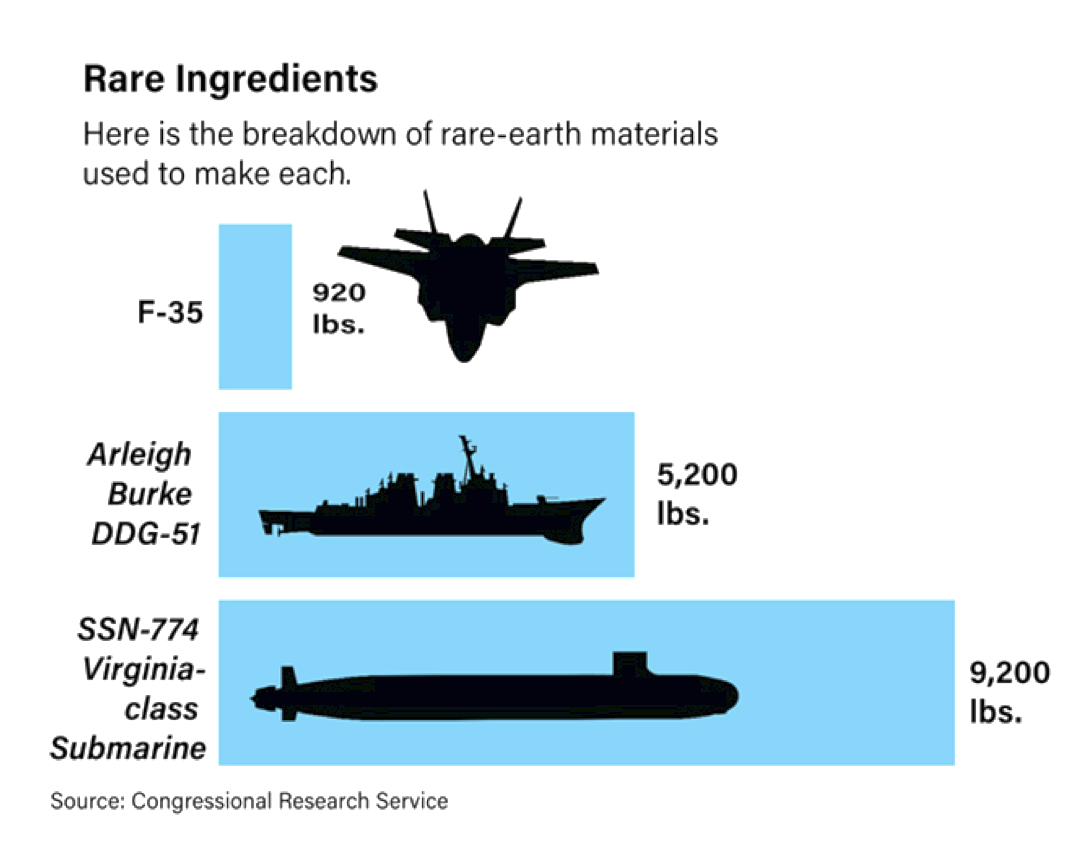
China cuts off exports to western world: China has recently cut off supply of their refined REE’s to the United States. This is in retaliation to the United State’s tariffs and semiconductor export restrictions. This retaliatory rare-earth element blacklist has taken a severe toll on the United States. CBy cutting off these critical materials , it has choked the production of F-35 fighters and Virginia class submarines, crippled EV manufacturing, and stalled assembly of semiconductor tools. Ironically these semiconductors were the very export the US originally restricted, triggering the REE blacklist in the first place.
Strategic Consequences of Rare Earth Dependence
National Security Vulnerabilities: Critical aerospace systems, including fighter jets, satellites and missile guidance technologies, depend on REEs. Supply disruptions could compromise military readiness. Limited access to REEs can also slow aerospace innovation, increase production costs and hinder competitiveness in high-tech markets.
Supply Chain Resilience and Mitigation: Diversification of sources, domestic mining initiatives, recycling programs and investment in alternative processing technologies are essential to reduce strategic dependency.
Exponential Increase in REE Cost: The limited access to REEs mixed with the drastic increase in demand, could significantly increase the value of certain REEs, as per an Air and Space forces article, “...demand for dysprosium (a ‘heavy’ REE) might surge by %2600 over 25 years (per a cited MIT study)”, revealing the scale of the impact that this resource could have in the coming decades.
Conclusion
Rare earth elements are a critical and often underappreciated component of aerospace capability. They enable technological innovation, sustain defense readiness and support the aerospace industry’s long-term growth. Ensuring supply chain resilience and developing domestic production capacities are vital to maintaining national security, technological leadership and global competitiveness.
Index:
15 lanthanides: Lanthanum, Cerium, Praseodymium, Neodymium, Promethium, Samarium, Europium, Gadolinium, Terbium, Dysprosium, Holmium, Erbium, Thulium, Ytterbium, Lutetium.
Scandium: a soft, silvery-white metallic chemical element with the symbol Sc and atomic number 21.
Yttrium: a lustrous, silvery-white metallic element with the symbol Y and atomic number 39.
Sources
- Army-Technology. (n.d.). Securing the rare earth supply chain is crucial for defence. Retrieved fromhttps://www.army-technology.com/features/securing-the-rare-earth-supply-chain-is-crucial-for-defence/
- Grier, P. (2017, December 21). Rare-Earth Uncertainty. Air & Space Forces Magazine. Retrieved from https://www.airandspaceforces.com/article/rare-earth-uncertainty/
- Schifrin, N., & Sagalyn, D. (2025, April 15). China cuts exports of vital rare-earth minerals as trade war with U.S. intensifies. PBS NewsHour. https://www.pbs.org/newshour/show/china-cuts-exports-of-vital-rare-earth-minerals-as-trade-war-with-u-s-intensifies
- Baskaran, G., & Schwartz, M. (2026, April 27). Rare earth export restrictions: One year later. Center for Strategic and International Studies. https://www.csis.org/analysis/rare-earth-export-restrictions-one-year-later
Get new science and medicine stories as they publish.
Subscribe by email, save the reader links page, or send a note to the editors.
Student contributors can join a 501(c)(3) nonprofit and PVSA-certified organization built for meaningful science communication service.
Questions or story tips: theyouthsentinel@gmail.com